One Conscious Blink: The Tiny Reset That Stops Your Worst Reactions Before They Happen
Your Brain Is Running on Autopilot — And It's Not Always Driving Well
Here's a scenario that probably feels familiar: You get a passive-aggressive Slack message from a colleague right before a big meeting. Your chest tightens. Your fingers are already moving toward the keyboard before you've consciously decided to respond. Thirty seconds later, you've sent something you'll spend the rest of the afternoon regretting.
That's not a character flaw. That's just your nervous system doing what it was designed to do — respond fast, protect you, keep things moving. The problem is, your brain doesn't always know the difference between a saber-toothed tiger and a mildly condescending email from Dave in accounting.
But here's the thing neuroscientists have been quietly piecing together: there's a window. A tiny, almost laughably small window between the moment something triggers you and the moment your automatic response kicks in. And inside that window? You actually have a choice.
The Neuroscience Behind the Pause (It's Weirder Than You'd Think)
The brain processes emotional stimuli through the amygdala — that almond-shaped cluster deep in your brain that acts as your internal alarm system. When something feels threatening, whether it's physical danger or a critical comment from your boss, the amygdala fires first. It's fast. Brutally fast.
But the prefrontal cortex — the part responsible for rational thinking, long-term planning, and not torpedoing your professional relationships — can catch up. It just needs a beat. A literal beat.
Researchers studying emotional regulation have found that even a brief interruption in the stimulus-response cycle can shift processing from the reactive amygdala toward more deliberate cortical thinking. In plain English: a pause literally changes which part of your brain is in charge.
Now, where does blinking come in?
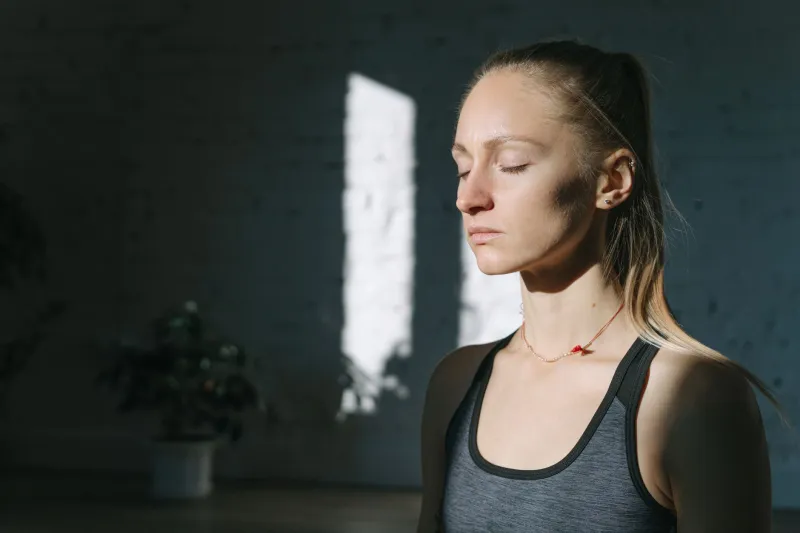
A conscious blink — one slow, intentional close and open of your eyes — takes roughly 300 to 400 milliseconds. That's not nothing. It's actually long enough to serve as a physical anchor, a micro-intervention that pulls your attention inward for just a fraction of a second. It's not about the blink itself. It's about what the intentionality of that blink signals to your nervous system: slow down, something's happening here.
Think of it as a circuit breaker you carry with you everywhere, built right into your face.
Real People, Real Patterns — And How They Broke Them
This isn't abstract theory. Professionals across industries have started incorporating micro-pause techniques into their daily workflows with genuinely surprising results.
A project manager at a mid-sized marketing agency in Chicago described a habit she'd been trying to break for years: firing off defensive emails whenever her work was questioned in group threads. "I'd get that familiar sting, and my hands would just start typing," she said. "I started doing this thing where I'd close my eyes for one second — just one — before I touched the keyboard. It sounds ridiculous, but it was like pressing pause on a reflex I didn't even know I had."
Over a few weeks, she noticed something shift. The emails she sent started sounding less like someone defending a castle and more like someone actually engaging with feedback. Her manager noticed too.
A financial analyst in New York used a similar approach to interrupt stress spirals during earnings season. "There's this moment where the numbers aren't adding up and I can feel the panic starting to build," he explained. "I started treating one slow blink like a reset button. It doesn't fix the numbers, obviously. But it stops me from catastrophizing before I even know what the actual problem is."
These aren't outliers. They're people who found a way to insert a sliver of consciousness into an otherwise unconscious chain of events.
Why Tiny Works Better Than Trying Harder
Here's the counterintuitive part: the reason this works is precisely because it's so small.
When we try to overhaul our reactions — through sheer willpower, long journaling sessions, or extensive therapy (all valuable, by the way) — we're often asking a lot of ourselves in the middle of a triggered state. That's like trying to rewire your car's electrical system while driving on the highway.
A micro-pause doesn't require you to be your best self in the moment. It doesn't demand that you've had eight hours of sleep or that you've been meditating for a decade. It just asks for one second. One blink. One tiny act of noticing.
And that noticing? That's the whole game.
Neuroscientists refer to this as "pattern interruption" — breaking the automatic loop that connects a specific trigger to a specific behavior. The more consistently you interrupt the loop, the weaker that automatic connection becomes. You're essentially starving the reflex of its momentum.
How to Actually Build This Into Your Day
You don't need a meditation cushion or a 20-minute morning routine to make this work. Here's how to start small:
Identify your trigger moments. Think about the situations that most reliably set off your worst responses. Criticism in meetings? A certain coworker's tone? Inbox overload at 4pm? Get specific.
Assign the blink to the trigger. Before you respond to an email that makes your blood pressure spike, blink once — slowly and intentionally. Before you jump into a defensive comment in a meeting, blink. Make the pairing deliberate until it becomes its own kind of habit.
Notice, don't judge. The point isn't to shame yourself for having reactions. It's to create just enough space to choose what happens next. Some days the blink will work beautifully. Other days you'll realize you already sent the email. That's fine. The awareness itself is progress.
Stack it with breath. If one blink gives you 400 milliseconds, pairing it with a single slow exhale gives you another three to four seconds. That's a genuinely meaningful gap — enough for your prefrontal cortex to show up to the party.
The Smallest Shift Can Redirect the Whole Day
What makes this approach feel so aligned with how real life actually works is that it doesn't ask you to become a different person. It just asks you to show up for one small moment — a moment that, it turns out, contains a lot more power than it looks like from the outside.
Your automatic responses were built over years of conditioning, stress, and survival. They're not going anywhere overnight. But every time you insert that tiny pause, you're adding a little friction to the old pattern and a little space for something new.
One blink. That's the entry point.
And sometimes, the entry point is all you need.